
TL;DR
Secta is the stronger candidate to investigate for post-generation refinement; Aragon is worth evaluating for a straightforward professional-headshot workflow. Those recommendations are provisional because the supplied research lacks current package details and matched test results. Compare checkout terms, usable-image yield, and editing access before purchasing.
A gallery of attractive headshots doesn't establish how many photos a buyer can actually use. Secta AI vs Aragon AI comes down to three practical questions: what the package includes, how closely the results preserve identity, and how much control remains after generation.
AI headshot generator: A service that uses artificial intelligence to create portrait images from submitted photos or other inputs.
For professionals considering broader personal-brand imagery, Looktara also belongs on the shortlist. The useful starting point is a clear brief: one LinkedIn portrait, several business images, or a consistent profile collection.
Guide navigation
- Package evidence
- Testing usable results
- Post-generation control
- Buyer decisions
- Frequently asked questions
Table of Contents
Package evidence for 2026
Current package inclusions cannot be verified from the supplied research, so neither Secta nor Aragon can be declared the better-value purchase on price alone.
The research contains search summaries and competitor article outlines, including material dated 2025. It does not include current checkout pages, official feature documentation, or matched image samples. Claims about exact prices, delivery times, upload requirements, refunds, and image quantities would therefore exceed the evidence.
The supplied summaries suggest a useful distinction: Secta receives attention for customization and post-generation refinement, while Aragon receives attention for professional-headshot quality. These are starting points for evaluation, not independently established performance findings.
Side-by-side evidence snapshot
The comparison below separates each service's suggested role from facts that still need confirmation.
| Decision factor | Looktara | Secta AI | Aragon AI |
|---|---|---|---|
| Evaluation focus | Personal-brand imagery fit | Customization and refinement | Professional-headshot workflow |
| Evidence available here | Product name and website | Search summaries and article outlines | Search summaries and article outlines |
| Package check | Review current offering | Confirm generation and editing inclusions | Confirm generation and editing inclusions |
| Best evaluation question | Does the offering match the image brief? | How much useful control follows generation? | How directly does the workflow deliver a publishable portrait? |
Exact package numbers remain unverified. A claim that Aragon offers over 100 looks appears in a supplied search summary, but it lacks package context and should not be treated as a current entitlement.
Before payment, record the selected tier's price, output count, resolution, delivery estimate, editing allowance, refund conditions, and image-use terms. A dated checkout record is more useful than an older roundup's headline ranking.
How should buyers test usable headshot yield?
Buyers should test usable headshot yield by comparing equivalent inputs and judging publishable results rather than total output:
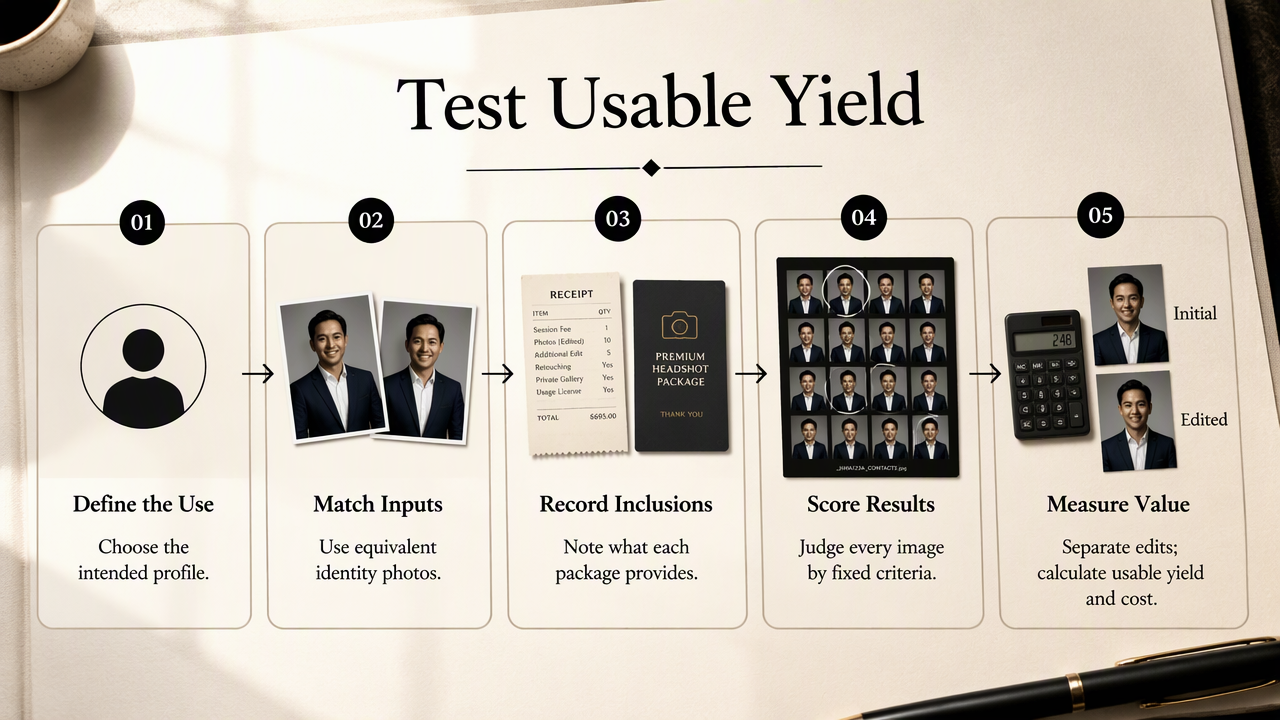
- Define the intended profile use.
- Prepare an eligible, consistent photo set.
- Record each package's inclusions.
- Score every delivered image against fixed criteria.
- Separate initial results from edited results.
- Calculate usable yield and cost per usable image.
A fair comparison needs matched inputs
A fair comparison gives both services the same underlying identity information wherever their upload rules allow. Otherwise, differences in source-photo quality can be mistaken for differences in the generator.
The photo set should represent the subject's current appearance. Follow each service's requirements, and record any differences in accepted inputs. A test using recent, clear photographs for one platform and inconsistent photographs for another cannot support a reliable winner.
The supplied research contains no matched test dataset, so this guide proposes a method rather than reporting a hands-on experiment.
Measure publishable images, not gallery size
Usable-result yield measures the share of delivered images that meet a predefined publishing standard.
- Identity fidelity: The portrait remains recognizably the same person.
- Technical quality: Eyes, teeth, hair, glasses, clothing, and edges withstand inspection.
- Context fit: Expression, background, and styling suit the intended profile.
- Crop flexibility: The image works in the platform's actual display shape.
Define usable yield = usable images / delivered images. Also calculate cost per usable image = package cost / usable images when at least one image passes. These are evaluation formulas, not published benchmarks.
Record duplicate-looking images separately. Several nearly identical portraits may offer less practical variety than a smaller collection of distinct, suitable compositions.
A large gallery is an output measure; a publishable portrait is a buyer outcome.
Post-generation control and image authenticity
Post-generation control matters when an otherwise suitable portrait needs a specific adjustment without changing the subject's identity.
The supplied summaries associate Secta with customization, but they do not document its current editing tools or limits. Aragon's current controls are also unspecified. Buyers should verify actual operations rather than assume that a general promise of personalization includes every adjustment.
Separate selection, variation, and correction
Selection, variation, and correction solve different problems and should be evaluated separately.
- Selection: Choosing an existing image from the delivered gallery.
- Variation: Generating another version with a different background, outfit, or composition.
- Correction: Fixing a particular detail while preserving the rest of the portrait.
A service may support one category without supporting the others. Check whether changes use credits, whether the original remains available, and whether a revised result preserves facial proportions.
An efficient test requests one meaningful change and compares the original with the revision. Judge the requested improvement and identity preservation separately.
Match authenticity to the publishing context
Professional and dating profiles need recognizable portraits, even when their preferred presentation differs.
A LinkedIn image may suit restrained styling and a simple background. An entrepreneur's website may need compositions that fit surrounding brand material. Dating profiles benefit from an image that represents how the person currently appears, rather than an idealized substitute.
For all three uses, inspect the final crop at its intended display size and at full resolution. An attractive thumbnail can conceal details that become noticeable in a larger image.
Refinement earns its value when it improves presentation without rewriting identity.
Who should pick which headshot service?
Secta is the more relevant candidate for buyers prioritizing refinement, while Aragon is worth evaluating for buyers prioritizing simplicity; both recommendations remain conditional on current package checks.
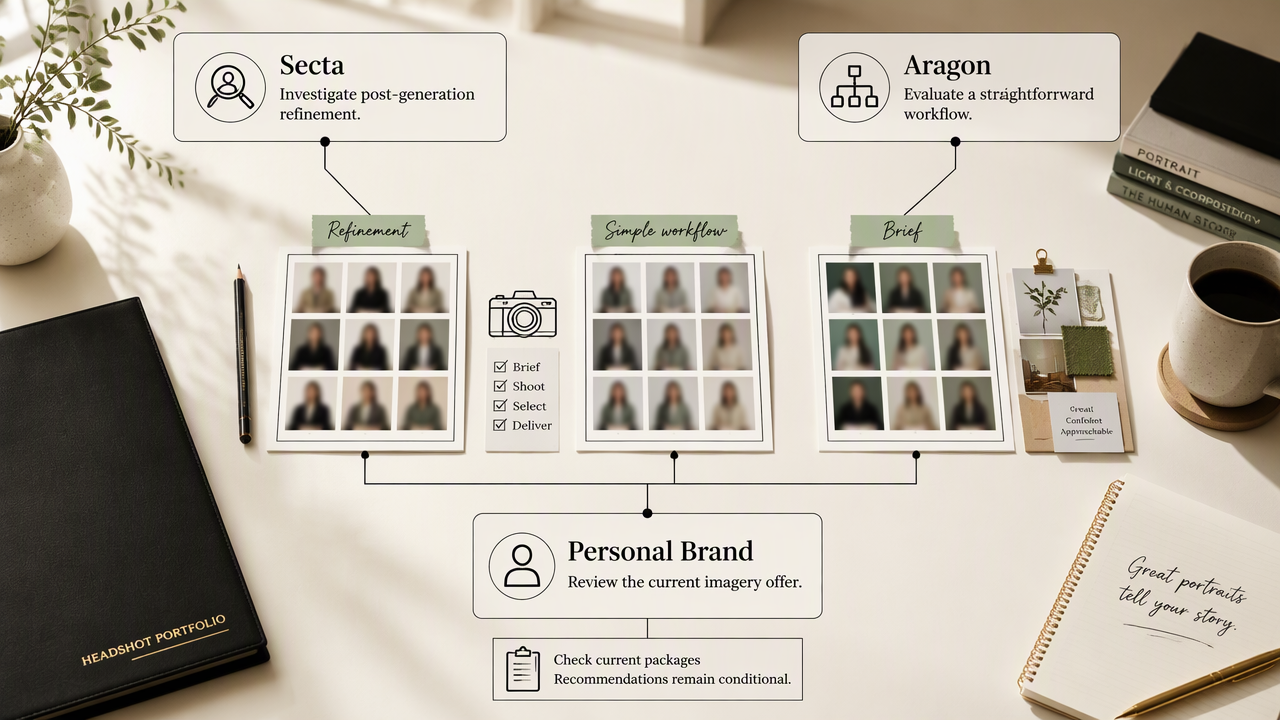
The research summaries support investigating those roles, but they do not prove a universal quality winner. A sensible decision matches the workflow to the brief instead of treating every portrait need as interchangeable.
How Looktara handles this
The platform can be considered as an additional option for the personal-brand imagery brief, with its current offering reviewed directly before selection.
A practical evaluation starts with the desired image collection: profile portrait, website imagery, or social content. Compare that brief with the service information at looktara.com. The supplied context does not establish particular generation or editing capabilities, so a feature-level recommendation requires that direct review.
Choose simplicity or refinement deliberately
The clearest choice depends on how much work the buyer wants to do after the first gallery arrives.
- Simplicity-first buyer: Evaluate Aragon for a direct route to a professional portrait, then confirm upload effort, delivery expectations, and selection steps.
- Refinement-first buyer: Evaluate Secta for post-generation flexibility, then verify the exact available changes and their cost.
- Team buyer: Compare administration, consistent styling, usage rights, and approval workflows separately from individual image quality.
Before selecting either package, assess how many usable images the brief actually requires. One strong LinkedIn portrait and a varied website collection are different purchasing goals.
Provisional verdict: investigate Aragon for simplicity and Secta for refinement; choose the package that demonstrates the required result with the least total effort.
Frequently asked questions
The remaining buyer questions concern current prices, output quality, profile suitability, and uploaded-photo handling.
Is Secta AI better than Aragon AI?
Secta cannot be declared universally better from the supplied evidence. Search summaries favor its customization angle, while other summaries favor Aragon's professional-headshot quality. A defensible winner requires current package information and comparable results from the same subject. Buyers should judge recognizable, publishable images rather than rely on conflicting roundup rankings.
Which service is cheaper in 2026?
Neither service's current price is established in the supplied research. Compare the final checkout amount for equivalent needs, including any editing or regeneration costs. Package price alone is incomplete: cost per usable image provides a more practical comparison once results are available, while a pre-purchase decision must also consider the published refund conditions.
Can AI headshots be used on LinkedIn?
AI-generated headshots can be evaluated for LinkedIn use when they accurately represent the person and meet the platform's current requirements. The research does not provide LinkedIn policy text, so it cannot establish a policy guarantee. The practical quality test is recognition, a suitable crop, and professional presentation without misleading changes to appearance.
What should buyers check before uploading photos?
Buyers should check retention periods, deletion procedures, model-training permissions, image-use rights, and support contact details before uploading personal photographs. The supplied material does not establish either service's current policies. Review the selected provider's published terms, distinguish uploaded-photo handling from generated-image rights, and retain a dated copy of the relevant purchase conditions.
Conclusion
The strongest Secta AI vs Aragon AI decision starts with a written image brief and ends with a publishable-result check. Confirm current packages, assess refinement needs, and score images using the same standard. For a broader personal-brand imagery shortlist, review Looktara against that same brief. The next step is specific: document the required images and compare the current offerings before purchasing.
Generated by EarlySEO.com