
TL;DR
Rajasthani-inspired AI portraits look best when prompts specify attire, jewelry, setting, pose, lighting, and cultural context in one clean instruction. The strongest results avoid vague words like "ethnic" and use details such as poshak, bandhani dupatta, kundan jewelry, desert courtyard light, and natural profile-photo framing.
A believable cultural portrait starts before image generation, inside the wording of the prompt. Rajasthani traditional look AI photo prompts work best when they combine respectful regional detail with modern portrait goals, such as LinkedIn, Instagram, creator branding, or dating profiles. Looktara helps turn those ideas into polished profile-ready images, while a clear prompt keeps the result grounded in recognizable Rajasthani visual cues rather than generic costume styling.
Table of Contents
What are Rajasthani traditional look AI photo prompts?
Rajasthani traditional look AI photo prompts are text instructions that guide an AI image model to create portraits inspired by Rajasthan's clothing, jewelry, architecture, colors, lighting, and poses. A strong prompt names the subject, outfit, accessories, background, camera style, mood, and quality constraints in one structured description.
Prompt: A written instruction given to an AI image generator that describes the desired subject, setting, style, and visual details.
Rajasthan's visual identity is broad, so prompt quality matters. A wedding-style poshak, a folk-performance portrait, a desert travel profile, and a professional headshot with subtle Rajasthani styling should not use the same wording.
Key insight: Authenticity comes from specific cultural markers, not from adding many decorative words.
Research on image generation supports this careful approach. A 2023 ACM paper, AI's Regimes of Representation: A Community-centered Study of Text-to-Image Models in South Asia, examined representation issues in South Asian text-to-image systems, making cultural specificity and prompt framing especially relevant for Indian regional portraits.
Prompt structure that produces cleaner portraits
A reliable Rajasthani portrait prompt uses six parts:
- Subject: age range, expression, posture, and face preservation if using a reference photo.
- Attire: poshak, ghagra choli, angarkha, kurta, dhoti, or bandhani dupatta.
- Jewelry: borla, aad necklace, bangles, jhumkas, anklets, or kundan details.
- Setting: haveli courtyard, Thar Desert, blue Jodhpur street, palace arch, or village wall.
- Lighting: golden hour, soft studio light, warm window light, or cinematic dusk.
- Use case: profile photo, editorial portrait, couple shoot, festive image, or creator post.
Which Rajasthani details make AI portraits feel authentic?
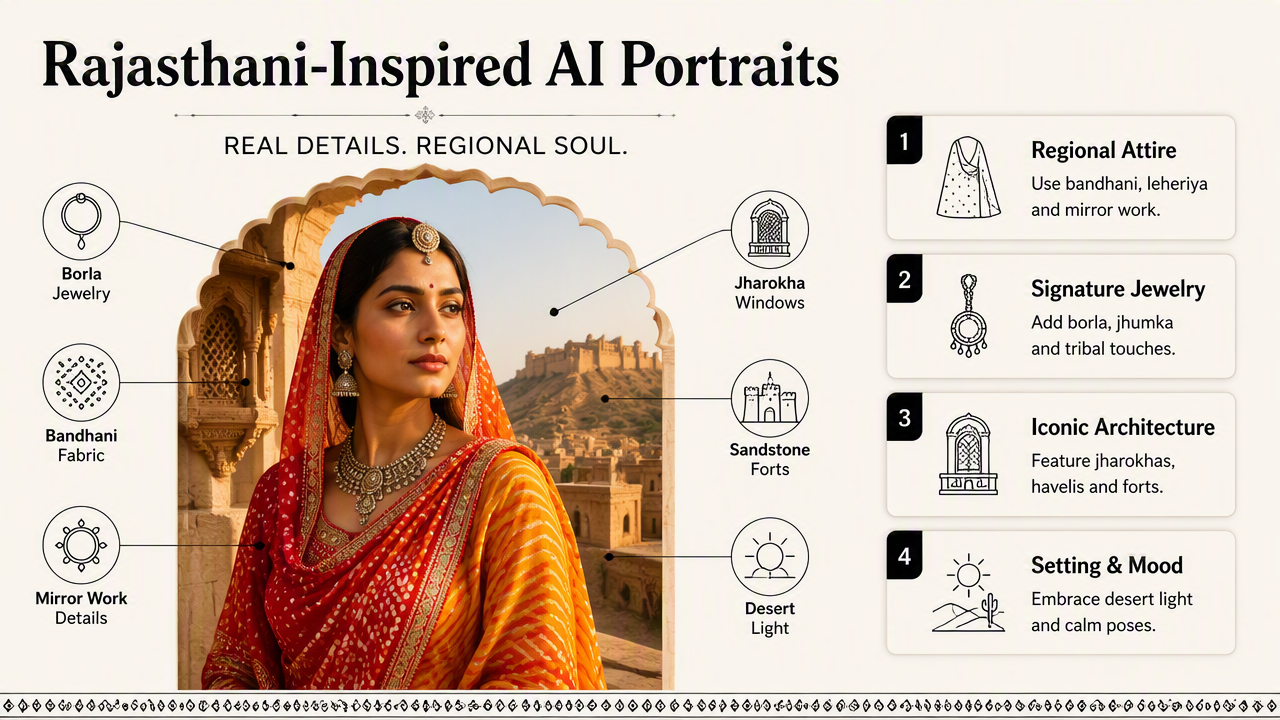
Authentic Rajasthani-inspired AI portraits use regionally recognizable clothing, jewelry, architecture, color, and setting rather than broad "Indian traditional" labels. The most useful details include bandhani or leheriya fabric, mirror work, borla jewelry, jharokha windows, sandstone forts, desert light, and calm portrait poses.
Rajasthani culture also includes music, food, and craft references that can enrich backgrounds. Wikipedia's overview of Rajasthani musical instruments lists instruments such as ravanahatha, kamayacha, Sindhi sarangi, morchang, algoze, and ektara. A background musician holding one instrument can add atmosphere when the portrait is meant to feel editorial.
For lifestyle scenes, Rajasthani cuisine is described as the traditional cuisine of Rajasthan, shaped by factors such as local conditions and historic lifestyles. A courtyard meal scene can mention dal baati churma, brass thali, or earthenware only when food is part of the story.
Visual detail checklist for stronger prompts
| Prompt element | Good Rajasthani detail | Best use case |
|---|---|---|
| Fabric | Bandhani, leheriya, gota patti, mirror work | Festive portraits, creator posts |
| Women's attire | Poshak, ghagra choli, odhni, kanchli | Bridal, cultural, fashion portraits |
| Men's attire | Angarkha, kurta, dhoti, safa, mojari | Couple shoots, professional cultural portraits |
| Jewelry | Borla, aad, kundan, jhumkas, bangles | Close-up portraits and formal images |
| Background | Haveli arch, jharokha, fort wall, desert dune | Travel, editorial, social profiles |
| Lighting | Golden hour, soft studio, warm courtyard light | Profile photos and cinematic images |
| Pose | Standing three-quarter pose, seated on charpai, hand on dupatta | Natural portraits without stiffness |
Color should be vivid but not chaotic. Rajasthani styling often uses rich reds, yellows, pinks, oranges, emerald greens, and royal blues, while skin tone and facial identity should stay natural. For professional uses, one strong color and one neutral background usually work better than full festival saturation.
Prompt collection for portraits, couples, and profiles
The best prompt collection covers different identity goals: professional, festive, romantic, creator-focused, and lifestyle. Each prompt below keeps the subject central, adds Rajasthani visual context, and avoids overloading the image with props.
These prompts can be adapted for a selfie-based workflow, a full AI portrait session, or a platform that preserves facial likeness. For professional profiles, the Looktara platform can pair cultural styling with polished portrait framing, including head-and-shoulders crops and clean backgrounds.
Copy-ready Rajasthani portrait prompts
- Professional cultural headshot: Create a realistic head-and-shoulders portrait of the subject in an elegant Rajasthani-inspired outfit, subtle bandhani dupatta, small kundan earrings, warm studio lighting, neutral beige background, confident expression, natural skin texture, sharp eyes, professional social profile style.
- Festive poshak portrait: Create a full-length portrait of the subject wearing a vibrant Rajasthani poshak with gota patti work, borla maang tikka, layered aad necklace, bangles, soft golden hour light, haveli courtyard, graceful three-quarter pose, realistic fabric texture.
- Men's royal-inspired portrait: Create a realistic portrait of the subject wearing an ivory kurta, embroidered angarkha jacket, colorful safa, mojari footwear, sandstone fort background, relaxed standing pose, warm sunset light, editorial magazine style.
- Desert lifestyle portrait: Create a natural portrait of the subject in a leheriya dupatta and simple silver jewelry, Thar Desert dunes behind, soft wind movement in fabric, calm smile, cinematic warm light, realistic travel photography.
- Creator profile image: Create a bright social media portrait of the subject in a modern blouse with Rajasthani mirror-work jacket, clean colorful wall, soft shadows, expressive pose, high-detail face, natural makeup, vertical 4:5 crop.
Couple and social-profile variations
For couple prompts, balanced styling matters. The man and woman should not look like they came from two unrelated eras. A good couple prompt names both outfits, shared color harmony, and a setting that supports the relationship story.
- Rajasthani couple portrait: Create a realistic couple portrait in a palace courtyard, one subject wearing a red and gold poshak with borla and aad necklace, the other wearing cream kurta, embroidered waistcoat, and saffron safa, warm evening light, gentle smiles, natural body language.
- Minimal LinkedIn-friendly style: Create a polished profile photo of the subject with subtle Rajasthani styling, plain kurta or blouse, small traditional jewelry, clean background, soft studio light, confident expression, realistic headshot crop.
- Instagram editorial style: Create a colorful vertical portrait with bandhani fabric, jharokha window, soft cinematic glow, natural face, fashion editorial pose, detailed textile texture, no cartoon effects.
Professionals who need a profile image for hiring or consulting can compare outputs against AI images for LinkedIn profile use. Creators planning colorful campaign visuals may also find Instagram product-photo styling useful for framing, crop, and visual consistency.
How can prompts avoid costume-like or inaccurate results?
Prompts avoid costume-like results by using precise regional terms, realistic portrait language, and clear limits on exaggeration. The safest approach is to describe one authentic outfit, one believable setting, and one practical photo purpose instead of asking for every cultural symbol at once.
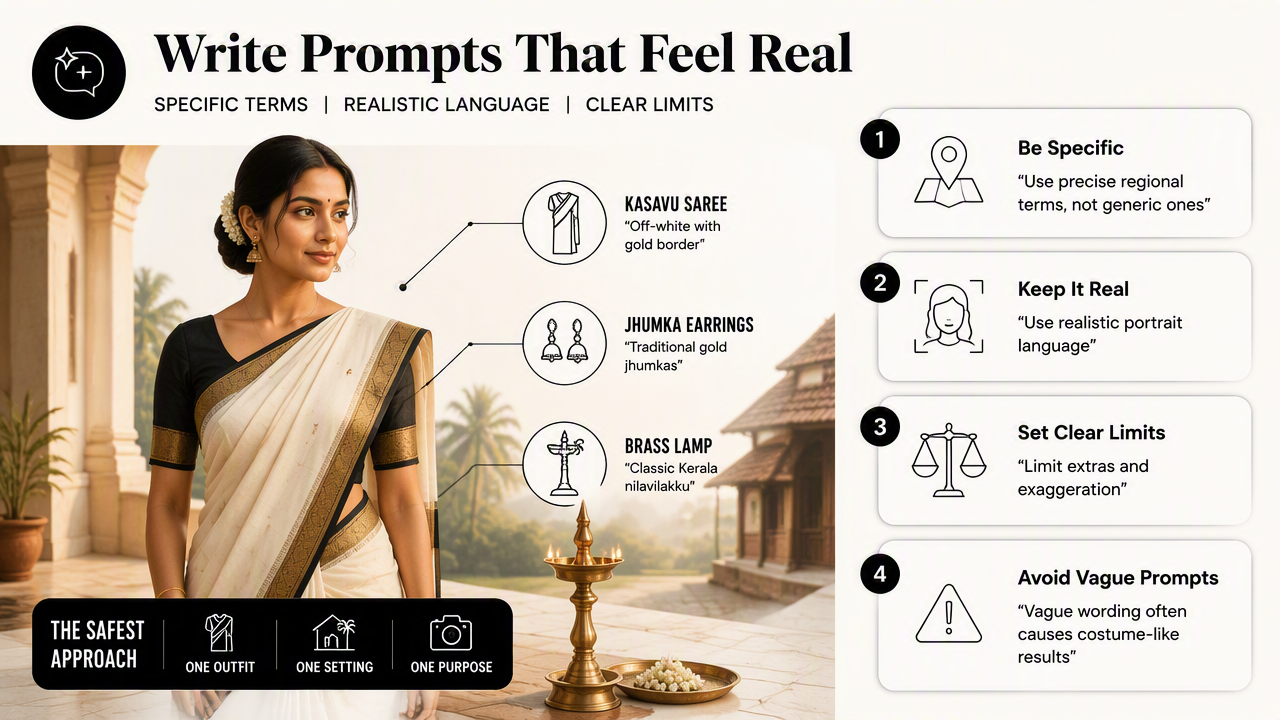
Vague wording often causes weak output. Terms such as "royal Indian princess," "ethnic queen," or "traditional village girl" can push models toward fantasy styling, mismatched jewelry, or theatrical poses. Better wording names the garment, accessory, region, and lighting.
Key insight: A respectful prompt edits for restraint. Too many symbols can make the image less authentic, not more authentic.
Common mistakes and cleaner fixes
| Common prompt issue | Why it weakens the image | Better wording |
|---|---|---|
| "Indian traditional dress" | Too broad for Rajasthan | "Rajasthani poshak with bandhani odhni" |
| "Lots of jewelry" | Creates clutter and errors | "Borla, jhumkas, aad necklace, glass bangles" |
| "Royal palace princess" | Can look fantasy-like | "Elegant portrait near sandstone jharokha" |
| "Village background" | May become stereotyped | "Mud-plastered courtyard with warm natural light" |
| "Ultra-beautiful face" | Can alter identity | "Preserve natural facial features and skin texture" |
Negative prompts help when models over-style the image. Useful exclusions include: plastic skin, extra fingers, distorted jewelry, inaccurate face, cartoon style, fantasy armor, exaggerated crown, random text, watermark, and over-sharpened fabric.
How should these prompts be used for social profiles in 2026?
In 2026, the strongest social-profile portraits balance cultural identity with platform fit. A LinkedIn image needs clarity and trust, an Instagram image can carry stronger color and movement, a Pinterest image benefits from vertical storytelling, and a newsletter portrait should feel editorial but approachable.
A single Rajasthani-inspired shoot concept can produce several profile assets. The professional version may use soft studio light and minimal jewelry. The creator version can use brighter fabric, architectural background, and a 4:5 crop. The dating-profile version should feel natural, with relaxed expression and less formal posing.
Platform-fit guide for 2026 and 2027
| Platform goal | Prompt adjustment | Recommended crop |
|---|---|---|
| LinkedIn or resume | Subtle attire, clean background, direct eye contact | 1:1 headshot |
| Strong color, textile detail, expressive pose | 4:5 vertical | |
| Storytelling background, full outfit, warm light | 2:3 vertical | |
| Newsletter bio | Editorial portrait, calm expression, soft contrast | 3:4 portrait |
| Dating app | Natural smile, relaxed outfit, believable setting | 4:5 or 1:1 |
Entrepreneurs and coaches planning brand images can study newsletter-ready AI product-photo framing for consistent visual tone. Visual creators building mood boards or pins can also use Pinterest-oriented AI photo formats as a reference for vertical composition.
Looking ahead to 2027, AI portraits are likely to reward more precise prompt intent and stronger identity controls. The safest future-ready habit is simple: keep cultural details named, keep faces natural, and create separate prompts for each platform instead of forcing one image to work everywhere.
Looktara is well suited for profile-photo workflows where cultural styling needs to stay polished, modern, and social-ready. For more examples and product options, visit looktara.com.
FAQ
What is the best prompt for a Rajasthani look?
The best prompt names the subject, Rajasthani attire, jewelry, setting, lighting, pose, and output style. A strong version might specify a poshak or angarkha, bandhani fabric, borla or safa, haveli courtyard, golden hour lighting, natural facial features, and a realistic profile-photo crop.
Can Rajasthani AI portraits be used for LinkedIn?
Rajasthani AI portraits can work for LinkedIn when the styling is subtle and professional. Clean backgrounds, soft lighting, direct eye contact, and minimal jewelry usually read better than heavy festive styling. The image should still look like a credible headshot rather than a themed fashion shoot.
How can facial likeness be preserved in AI photos?
Facial likeness is easier to preserve when the prompt asks for natural facial features, realistic skin texture, sharp eyes, and no face alteration. Reference-based tools should use clear source photos with good lighting. Overly dramatic beauty language can cause the model to change the subject's identity.
What should be avoided in cultural AI prompts?
Cultural prompts should avoid vague labels, fantasy royal styling, mixed regional symbols, exaggerated jewelry, and stereotypes. One clear outfit, one setting, and one lighting direction produce better results. Respectful specificity is safer than asking for a generic "traditional Indian" appearance.
Are Rajasthani couple prompts different from solo prompts?
Rajasthani couple prompts need visual balance between both people. The outfits should share a color palette, the pose should feel natural, and the setting should support both subjects equally. Naming each person's attire prevents the model from giving one subject much stronger styling than the other.
Conclusion
Rajasthani traditional look AI photo prompts work best when they are specific, restrained, and tied to a real use case. Start with attire, add jewelry and setting, choose lighting, define the platform crop, then add identity-preserving instructions. For polished social images, Looktara can turn a clear cultural concept into a profile-ready portrait that feels modern without losing regional character.
Generated by EarlySEO.com