
TL;DR
Headshot Kiwi is the faster, lower-cost option for polished profile images, while a traditional photographer offers more control, direction, and real-session authenticity. For LinkedIn, resumes, creator profiles, and dating apps, the best choice depends on budget, deadline, and how much human coaching matters.
Headshot Kiwi vs traditional photographer is really a choice between AI speed and human direction. Headshot Kiwi's search listing says its AI headshots start at $29 and are "8x cheaper than a photographer," while traditional studios often cost several hundred dollars and require scheduling. Professionals comparing those paths should also consider newer AI options such as Looktara, which focuses on quick profile-ready images for modern online use.
AI headshot generator: a tool that turns uploaded personal photos into styled headshots using machine learning, usually without a live shoot, studio, or photographer.
Key takeaway: AI headshots win on convenience and volume; traditional photography wins on live coaching, exact lighting control, and real-world authenticity.
Table of Contents
What is the difference between Headshot Kiwi and a traditional photographer?
Headshot Kiwi creates AI-generated professional headshots from uploaded images, while a traditional photographer captures new photos during a live session. The biggest differences are cost, speed, creative control, realism, and the amount of human guidance during the process.
Headshot Kiwi appears in search results as an AI-powered service built around natural-looking professional images. Competitor analysis from five ranking pages shows that 2026 comparison content often highlights subtle styling, fewer visual artifacts, and fast delivery as major AI advantages.
Traditional photography remains a service, not just an output. A photographer handles posing, expression coaching, lens choice, lighting, background, retouching, and usage fit. That matters when the headshot must match a corporate brand guide, speaker kit, publication bio, or investor deck.
Side-by-side comparison for 2026 decisions
| Factor | Headshot Kiwi | Traditional photographer | Best fit |
|---|---|---|---|
| Starting cost | Search data lists plans from $29 | Often several hundred dollars | AI for tight budgets |
| Time required | Usually upload-based and remote | Requires booking, travel, and shoot time | AI for urgent updates |
| Human coaching | Limited or absent | Strong posing and expression guidance | Photographer for confidence on camera |
| Image variety | Multiple generated looks | Depends on session length and package | AI for many profile options |
| Authenticity | Can look realistic if inputs are strong | Captures a real moment | Photographer for high-stakes trust |
| Control | Style choices within platform limits | Full control over wardrobe, set, light, and crop | Photographer for brand precision |
The practical split is simple: Headshot Kiwi is a productized image workflow, while a photographer is a guided creative session. Neither is automatically better for every person.
A job seeker updating LinkedIn before an application deadline may value speed more than custom lighting. A founder preparing press materials for a funding announcement may prefer a controlled shoot with consistent visual branding.
How do cost, speed, and convenience compare?
AI headshots are usually cheaper and faster because they remove the studio appointment, travel, live shooting time, and manual selection process. Traditional photographers cost more because the fee pays for expertise, equipment, direction, editing, and a custom session.
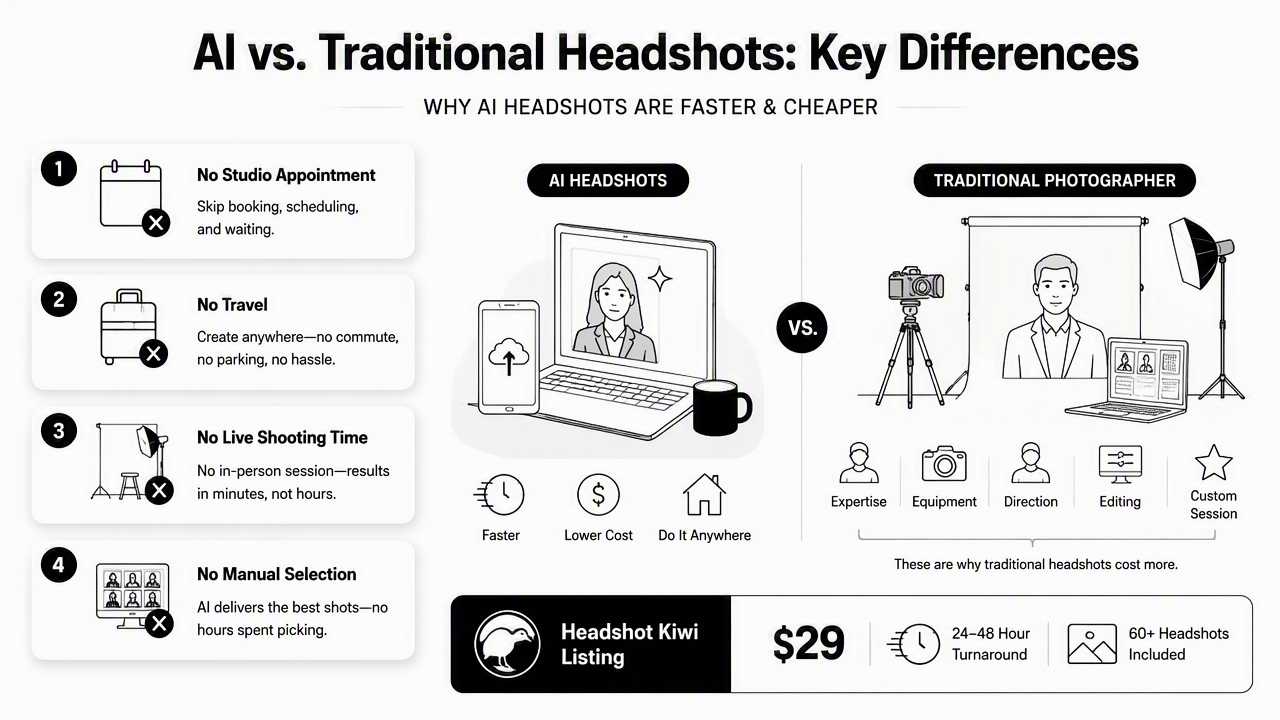
The visible Headshot Kiwi listing states that the service starts at $29 and positions itself as eight times cheaper than a photographer. That claim matches the general pattern found across ranking competitors: cost efficiency is the most repeated reason people consider AI headshots.
Speed also changes the decision. AI tools can generate many variations from existing images, which helps when different platforms need different crops or moods. A photographer may deliver stronger finals, but scheduling and editing can stretch the timeline.
When AI headshots save the most time
AI headshots tend to fit short-deadline profile updates and multi-platform testing.
- A professional needs a LinkedIn refresh before applications open.
- A freelancer wants several images for portfolio, resume, and marketplace profiles.
- A creator needs new thumbnails or bio images without booking a shoot.
- A remote worker lacks access to a local studio.
- A dating app user wants a polished image without a formal portrait session.
For resume-focused and social-profile use, a resume-ready AI headshot generator can be a practical next step when a polished image is needed quickly.
Decision rule: If the deadline is measured in hours or days, AI has the advantage. If the image will support a campaign, keynote, book jacket, or executive brand, a photographer deserves serious consideration.
Which option looks more realistic and professional?
A traditional photographer usually produces the most authentic headshot because the image is captured in camera, but modern AI tools can look professional when input photos are clear, varied, and recent. Realism depends less on the tool category and more on source quality, editing restraint, and final image selection.
Competitor research shows that Headshot Kiwi is often described as aiming for natural-looking professional headshots rather than dramatic styling. One analyzed ranking page says Headshot Kiwi produced images that felt closer to actual photos with fewer strange artifacts, which explains why realism is central to its appeal.
Still, AI images can fail in subtle ways. Skin texture may look overly smooth, teeth may appear slightly off, clothing can blend into the neck, and backgrounds may feel generic. A traditional photographer can correct these issues during the shoot before editing even begins.
Realism checklist before using any headshot
- Face accuracy: The final image should still look like the person on an ordinary workday.
- Eye detail: Pupils, catchlights, and eyelids should appear natural.
- Hands and accessories: Glasses, earrings, collars, and hairlines need close review.
- Skin texture: Professional retouching should clean distractions, not erase identity.
- Background logic: Lighting direction should match the face and clothing.
- Platform fit: LinkedIn, resumes, business websites, and dating profiles often need different levels of polish.
The Looktara platform is built for profile imagery where natural presentation matters more than heavy styling. That makes it relevant for professionals who want a clean image without making the photo feel staged.
Professional does not mean perfect. A slightly natural expression often earns more trust than a flawless but synthetic-looking portrait.
Who should choose Headshot Kiwi, a photographer, or Looktara?
Headshot Kiwi suits fast, affordable AI headshots; a traditional photographer suits custom, high-control portraits; Looktara suits people who want polished AI profile images for practical online use. The right pick depends on the job the image must perform.
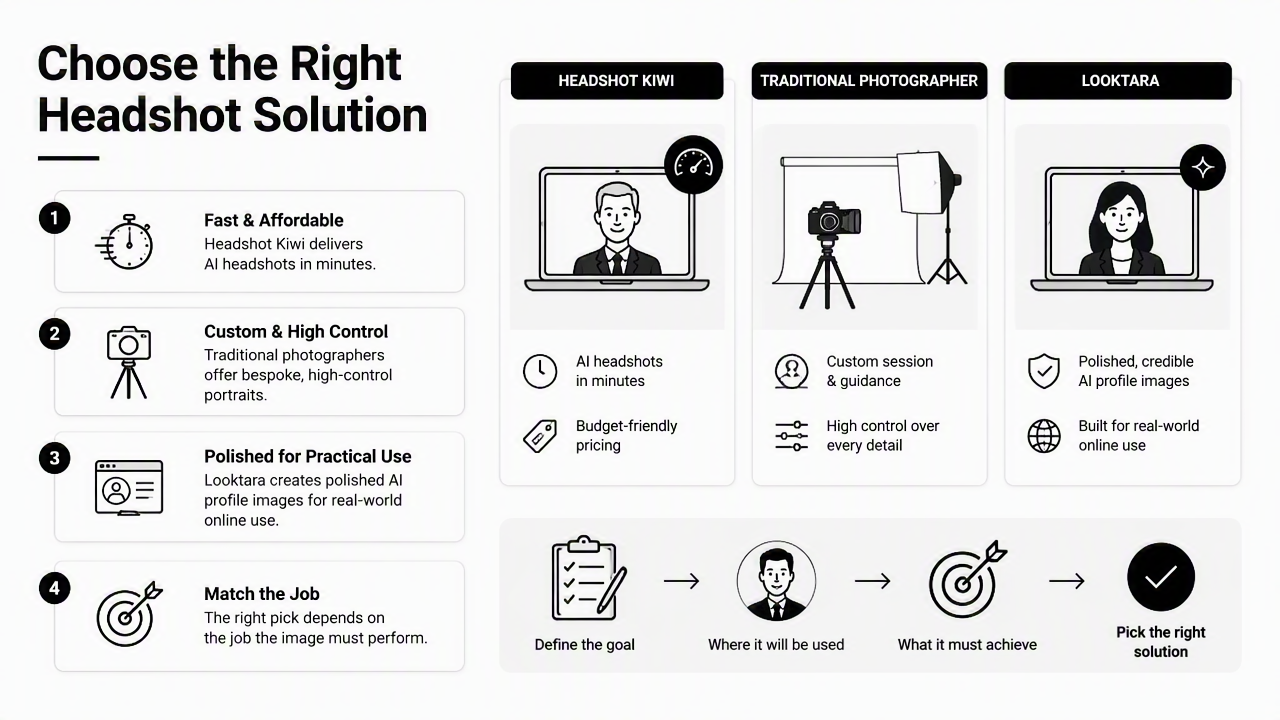
AI headshot tools are strongest when the goal is a credible profile refresh rather than a full brand shoot. Traditional photographers are strongest when the image must support reputation, press, paid campaigns, or a premium client-facing role.
Best choice by use case
| Use case | Best option | Why it fits |
|---|---|---|
| LinkedIn job search | Headshot Kiwi or Looktara | Fast, affordable, profile-friendly output |
| Executive website bio | Traditional photographer | Stronger control over brand tone and trust |
| Freelance marketplace profile | AI headshot tool | Multiple looks can be tested quickly |
| Dating app profile | AI with restraint or lifestyle photographer | Authenticity matters more than corporate polish |
| Speaker kit or press page | Traditional photographer | Publication-ready consistency and rights clarity |
| Creator profile refresh | Looktara | Practical for fast visual updates across channels |
Headshot Kiwi is a reasonable option when price and speed matter most. Its stated $29 starting point makes it attractive for early-career professionals, remote workers, and anyone testing several looks.
A photographer is a better fit when body language, wardrobe, environmental context, or personal coaching matters. Founders, consultants, agents, and executives often benefit from the confidence and nuance that come from a live session.
Looktara fits the middle ground for modern profile needs. For career, creator, and social use cases, visit looktara.com when the goal is a polished headshot workflow without arranging a studio shoot.
What should buyers expect from AI headshots in 2027?
AI headshots in 2027 will likely become more realistic, more personalized, and more clearly labeled across professional platforms. The strongest tools will focus less on dramatic makeovers and more on accurate identity, consistent lighting, and trustworthy business use.
Search results from 2026 already show the category moving toward natural styling. Ranking content for "best AI headshot generators" now emphasizes subtle edits, professional profiles, and fewer artifacts, not fantasy portraits or exaggerated transformations.
Traditional photographers will not disappear. Instead, the market will split. AI will handle routine profile updates, while photographers will own premium brand sessions, editorial portraits, team shoots, and situations where human direction carries clear value.
Likely standards for stronger AI headshots
- Better likeness preservation: Tools will need to keep faces recognizable, not just attractive.
- Clearer usage guidance: Business users will expect simple language around commercial rights.
- More style restraint: Natural lighting and realistic wardrobe will outperform glossy over-editing.
- Platform-specific crops: LinkedIn, resumes, websites, and social apps will need tailored formats.
- Higher disclosure expectations: Some employers and platforms may prefer transparency around AI-generated images.
A sensible 2026 approach is to treat AI headshots as profile assets, not identity replacements. The best image should look like the person who arrives on a video call, client meeting, or first date.
Frequently asked questions
A FAQ is a curated set of questions and answers that addresses common points of confusion. For this topic, the main concerns are cost, realism, professional acceptance, and when a live photographer is worth the extra effort.
Is Headshot Kiwi cheaper than a traditional photographer?
Headshot Kiwi is positioned as cheaper than traditional photography, with search data showing a starting price of $29 and a claim of being eight times cheaper than a photographer. Actual photographer rates vary by city, session length, licensing, retouching, and deliverables.
Are AI headshots acceptable for LinkedIn?
AI headshots can be acceptable for LinkedIn when they look natural, current, and recognizable. A strong LinkedIn image should show a clear face, simple background, professional clothing, and believable lighting. Overly polished or inaccurate AI images may reduce trust.
When is a traditional photographer worth the money?
A traditional photographer is worth the money when the headshot supports executive branding, media placement, consulting sales, speaking opportunities, or a company website. Live direction can improve posture, expression, wardrobe details, and confidence, which matters in high-trust roles.
Can Looktara replace a studio session?
Looktara can replace a studio session for many everyday profile updates, especially for resumes, LinkedIn, creator bios, and remote work profiles. A studio session still has an edge when exact art direction, team consistency, location context, or publication-grade files are required.
Conclusion
The fairest answer to Headshot Kiwi vs traditional photographer is not a universal winner. Headshot Kiwi is appealing for fast, low-cost AI headshots, while traditional photography offers unmatched human direction and custom control. Looktara also gives professionals and creators a practical AI route when polished online images are needed without a full shoot.
A smart next step is to define the image's job first: job search, dating profile, founder bio, creator page, or executive brand. If speed and budget lead the decision, test an AI option and review the results carefully for realism. If the headshot carries major business weight, book a photographer. For a fast profile refresh, head to looktara.com and create a clean, modern image fit for 2026 platforms.
Generated by EarlySEO.com