
TL;DR
Benchmark portrait generators using matched reference photos, blind identity ratings, and the share of outputs that meet a predefined acceptance standard. Report likeness separately from visual polish, and compare cost per usable portrait rather than advertised image counts.
A beautiful AI portrait can still depict the wrong person. Learning how to benchmark AI photo generators for portrait likeness means testing identity preservation, not simply choosing the most attractive image. For LinkedIn headshots, creator profiles, and dating photos, recognizable features matter as much as lighting and composition.
Portrait likeness: The degree to which a generated portrait preserves the recognizable identity of the person in its reference photographs.
Usable-result yield: The proportion of all generated outputs that satisfy a predefined acceptance standard.
The protocol below is a proposed evaluation method, not a published industry standard. Its sample sizes, scoring anchors, and acceptance rules are practical starting points rather than research-derived thresholds.
Table of Contents
Why are showcase images weak evidence of likeness?
Showcase images are weak evidence of portrait likeness because they reveal selected successes without showing the full output set, reference photographs, or selection process. Advertised image counts measure volume, not identity accuracy. A useful comparison evaluates every eligible output under the same rules and separates recognizable identity from attractiveness.
A generator producing many variations isn't necessarily producing many usable portraits. Likewise, a polished example cannot establish consistency across different faces, expressions, or camera angles.
Evidence that answers different buying questions
| Evidence | What it establishes | What remains unknown |
|---|---|---|
| Curated showcase | Selected images can look appealing | Typical likeness and selection effort |
| Advertised output count | Stated package volume | Number of acceptable portraits |
| Full matched test batch | Performance under documented conditions | Performance outside those conditions |
| Blind ratings with references | Assessed resemblance without brand cues | Wider population performance |
The 2021 paper More Real Than Real: A Study on Human Visual Perception of Synthetic Faces, by Federica Lago, Cecilia Pasquini, and Rainer Böhme, examines human perception of synthetic faces. That topic matters here, but judging whether a face looks real is a different question from judging whether it depicts a particular person.
Benchmark principle: Realism asks whether a portrait looks plausible. Likeness asks whether the intended person remains recognizable.
How should a matched portrait test be designed?
- Define the portrait's intended use and acceptance rules.
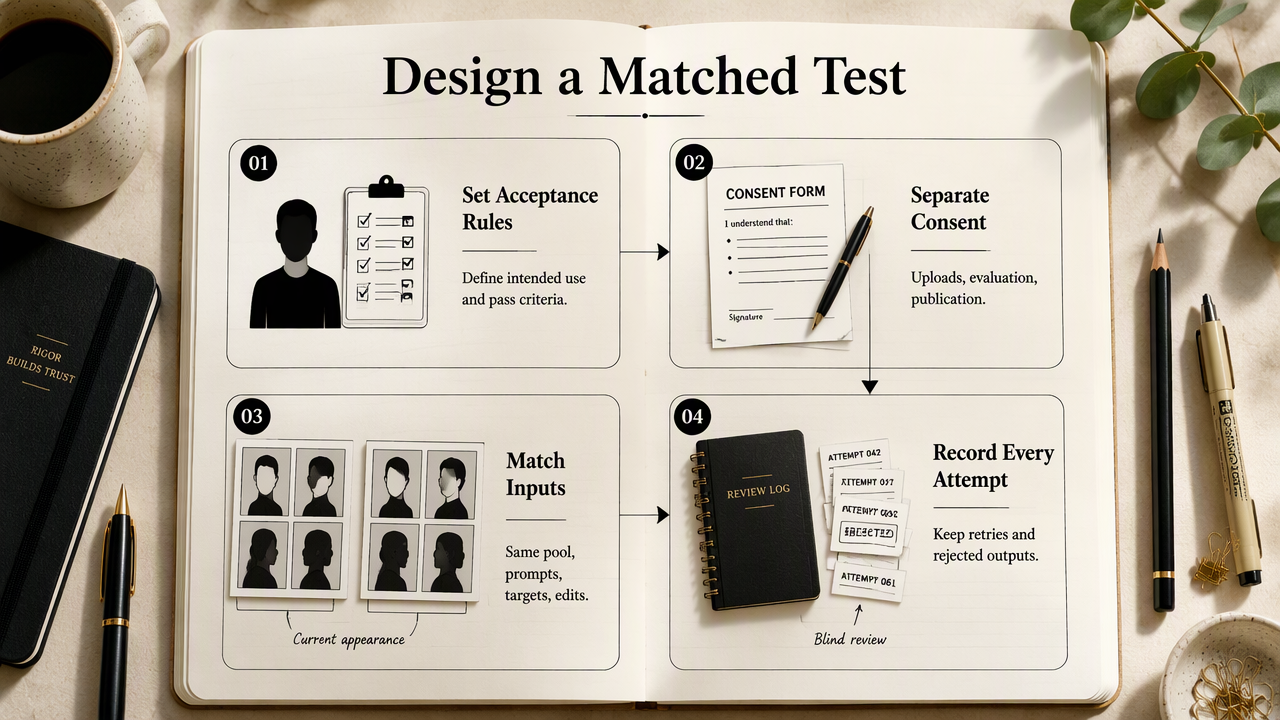
- Obtain consent for uploads, evaluation, and publication separately.
- Prepare the same reference-photo pool for each generator.
- Match prompts, output targets, and editing allowances.
- Record every attempt, including retries and rejected outputs.
- Randomize images before independent reviewers assess them.
Reference photos and consent boundaries
Use a reference pool showing the subject clearly across frontal and three-quarter views, with consistent current appearance. Avoid mixing substantially different ages or heavily filtered photos. Keep separate evaluation references that aren't uploaded, so reviewers can assess resemblance against additional photographs rather than only the training inputs.
When services require different upload counts, run a common-input test where possible and a separate recommended-input test. Label both clearly. Silently giving one service better photographs makes the comparison difficult to interpret.
Consent should cover the actual workflow, including any external face-analysis service. Document storage, access, deletion plans, and permission to publish examples. Publicly available profile photos shouldn't be treated as automatic permission for model training.
A small, repeatable pilot
An illustrative pilot could use five consenting adults, three portrait briefs, and ten outputs per brief per service. These are proposed design choices, not statistically validated minimums. A single-person test can guide that person's purchase, but cannot support broad claims about all users.
- Neutral headshot: Plain background, eye-level framing, natural expression.
- Professional profile: Business clothing, soft light, head-and-shoulders crop.
- Lifestyle portrait: Casual clothing, environmental background, relaxed expression.
Freeze prompts before generation. Keep every returned image in the evaluation ledger; record unavailable outputs separately. Repeat selected briefs to examine run-to-run variation, especially when services don't expose a reproducible seed.
How should likeness and usable yield be scored?
- Show reviewers each anonymous output beside evaluation references.
- Score identity preservation separately from realism and presentation.
- Check artifacts and suitability for the intended profile.
- Apply acceptance thresholds fixed before reviewing results.
- Calculate usable yield from the complete returned batch.
- Report reviewer disagreement alongside overall scores.
A reusable portrait-rating rubric
| Dimension | Reviewer question | Proposed scale |
|---|---|---|
| Identity preservation | Do facial proportions and distinctive features match? | 1: different person; 3: partial resemblance; 5: strong resemblance |
| Photographic realism | Do skin, lighting, and anatomy look plausible? | 1: obvious defects; 3: mixed; 5: convincing |
| Brief suitability | Does the image fit the specified use? | 1: unsuitable; 3: needs changes; 5: ready |
| Critical artifacts | Are there disqualifying distortions or alterations? | Pass or fail |
Keep identity as a gate rather than allowing flattering lighting to compensate for weak resemblance. An illustrative acceptance rule is identity at least 4, suitability at least 4, and no critical artifact. Agree on what counts as critical before scoring, such as altered facial structure or visibly distorted eyes.
Use at least three independent reviewers as a practical pilot choice. Hide provider names and randomize presentation order. Reviewers should score independently before discussing disagreements. The subject's own assessment can be reported separately, since self-recognition and presentation preferences answer related but different questions.
Yield, cost, and automated checks
Usable yield: Accepted outputs divided by all returned outputs, multiplied by 100.
In a hypothetical batch, 12 accepted portraits from 40 returned images produce a 30% usable yield. These numbers illustrate arithmetic, not any provider's performance. Report failed generation requests alongside this measure so operational reliability remains visible.
Cost per usable portrait: Total test expenditure divided by accepted outputs. Report selection time separately, and mark the cost as undefined when no portrait passes.
Optional face-embedding similarity can provide another signal, but shouldn't replace reference-based human review. Record the embedding model and preprocessing; don't compare scores from incompatible systems as though they share a universal scale. The 2024 review Deepfake video detection: challenges and opportunities concerns detection, which is distinct from validating portrait likeness.
What should a transparent benchmark report include?
A transparent portrait benchmark report should include the test date, service version when available, consent scope, reference-photo rules, prompts, output counts, scoring rubric, reviewer process, usable yield, and costs. Results should be broken out by subject and brief, with selection rules and uncertainty clearly stated rather than hidden behind one ranking.
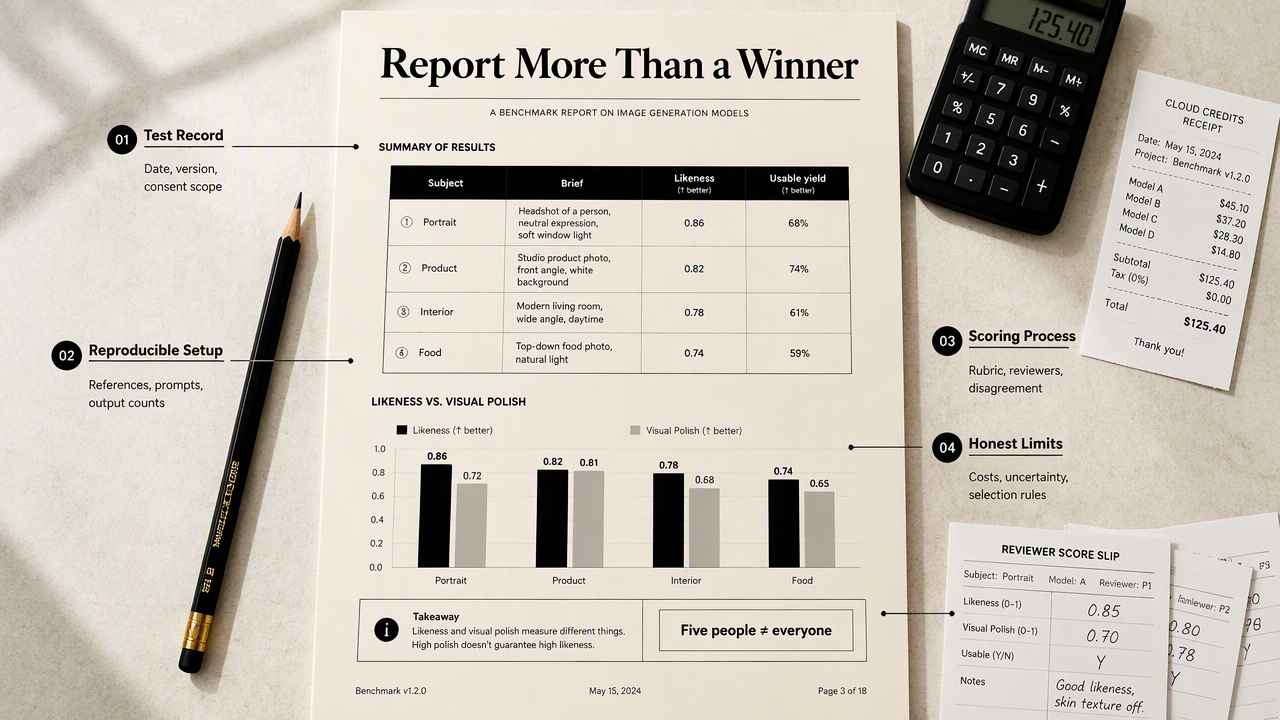
A five-person pilot is evidence about those five participants under those conditions. It isn't evidence of performance across every age, skin tone, hairstyle, or accessibility need. Reviewer disagreement also deserves attention: a median score can conceal sharply different judgments.
A publication-ready reporting checklist
- Publish the protocol and acceptance rules alongside results.
- Show representative examples using a declared selection method.
- Report per-subject scores, rating spread, and accepted-image counts.
- Separate unedited results from retouched or upscaled versions.
- Disclose sponsorships, credits, and evaluator relationships.
Keep dated records so a 2026 comparison can be repeated after service updates. Re-testing the same briefs helps distinguish an actual change from a different selection of examples.
Applying the protocol with Looktara
Looktara provides a relevant starting point for a portrait-focused trial using the same predefined brief and evaluation process. Recording the chosen workflow makes the results easier to interpret for a specific professional use.
For a fitness business owner, a resume-headshot workflow provides a concrete professional brief. A LinkedIn-post workflow supplies a separate brand-content context. Evaluate these uses separately because headshot framing and promotional composition serve different purposes.
FAQ: Portrait benchmark decisions
Portrait benchmark decisions should prioritize recognizable identity, use-specific acceptance, and documented evaluation conditions.
Decision rule: Choose evidence that matches the intended portrait use, rather than the most impressive showcase.
Can one reference selfie support a fair comparison?
One selfie can support a narrowly defined single-image test when every service accepts that input. It doesn't represent workflows designed around multiple photographs. The report should label the test accordingly and include separate evaluation references if available. A second, recommended-input test can show how each service performs under its intended setup.
Should attractiveness count toward portrait likeness?
Attractiveness should remain separate from portrait likeness because a flattering image can change recognizable features. Reviewers can score presentation quality, but that score shouldn't rescue an identity failure. For dating profiles or professional headshots, the subject should also confirm that the accepted image represents their current appearance rather than merely an appealing variation.
Does a high face-similarity score prove a portrait is usable?
A high face-similarity score doesn't establish complete portrait usability. The image may still contain distracting artifacts, unsuitable clothing, or framing that misses the brief. Automated similarity is best treated as supporting evidence within a documented evaluation. Human reviewers should assess identity, realism, and suitability separately before the portrait enters the accepted set.
Conclusion
Start with one clearly defined portrait use, a consented reference pool, and a frozen scoring sheet. Run the same pilot across shortlisted services, then compare accepted portraits and selection effort. For a practical next step with Looktara, visit looktara.com, select a professional portrait workflow, and record the test conditions before generation. Choose the result supported by repeatable evidence, not the largest gallery.
Generated by EarlySEO.com