
TL;DR
PR professionals need headshots that signal credibility, warmth, and media readiness across LinkedIn, press kits, agency bios, and event pages. AI headshots work best when source photos are current, styling is consistent, and final images are reviewed for authenticity before public use.
An AI headshot for public relations professionals has to do more than look polished; it has to support trust before a pitch, byline, webinar, or crisis response ever begins. Public relations: the practice of managing and sharing information from a person or organization to influence public perception. For PR pros, that means a headshot is part of the message. Looktara helps communications professionals turn everyday photos into profile-ready images that feel articulate, approachable, and suitable for media-facing work.
Table of Contents
What is an AI headshot for public relations professionals?
An AI headshot for public relations professionals is a computer-generated professional portrait created from uploaded photos and adapted for PR uses such as LinkedIn, agency pages, speaker bios, press kits, author bylines, and event programs. The best version looks current, recognizable, polished, and aligned with the communicator's role.
AI headshot tools use image models to learn facial structure, expression, lighting, and styling patterns from source photos. Modern multimodal AI has advanced quickly; the 2024 Gemini 1.5 technical report describes systems built to understand large amounts of visual and textual context, which reflects the broader direction of AI-assisted content creation.
Key terms for PR teams:
- Source photos: Real images uploaded to train or guide the generated headshot.
- Brand consistency: A repeatable visual style across team bios, decks, and press materials.
- Media-ready image: A headshot that can be used without heavy cropping, distracting backgrounds, or unclear lighting.
- Authenticity check: A human review to confirm the image still looks like the actual professional.
A PR headshot should not feel like a glamour shot. It should feel like a credible first handshake with a journalist, client, event host, or stakeholder.
For career-driven updates, a tool focused on LinkedIn and resume headshots can help align profile imagery with hiring, networking, and thought-leadership goals.
What should a PR headshot communicate in 2026?
A PR headshot in 2026 should communicate credibility, clarity, approachability, and message discipline. Public relations professionals are often evaluated before a meeting through LinkedIn, media kits, conference pages, agency directories, and social profiles, so the image needs to match the tone of the work being represented.
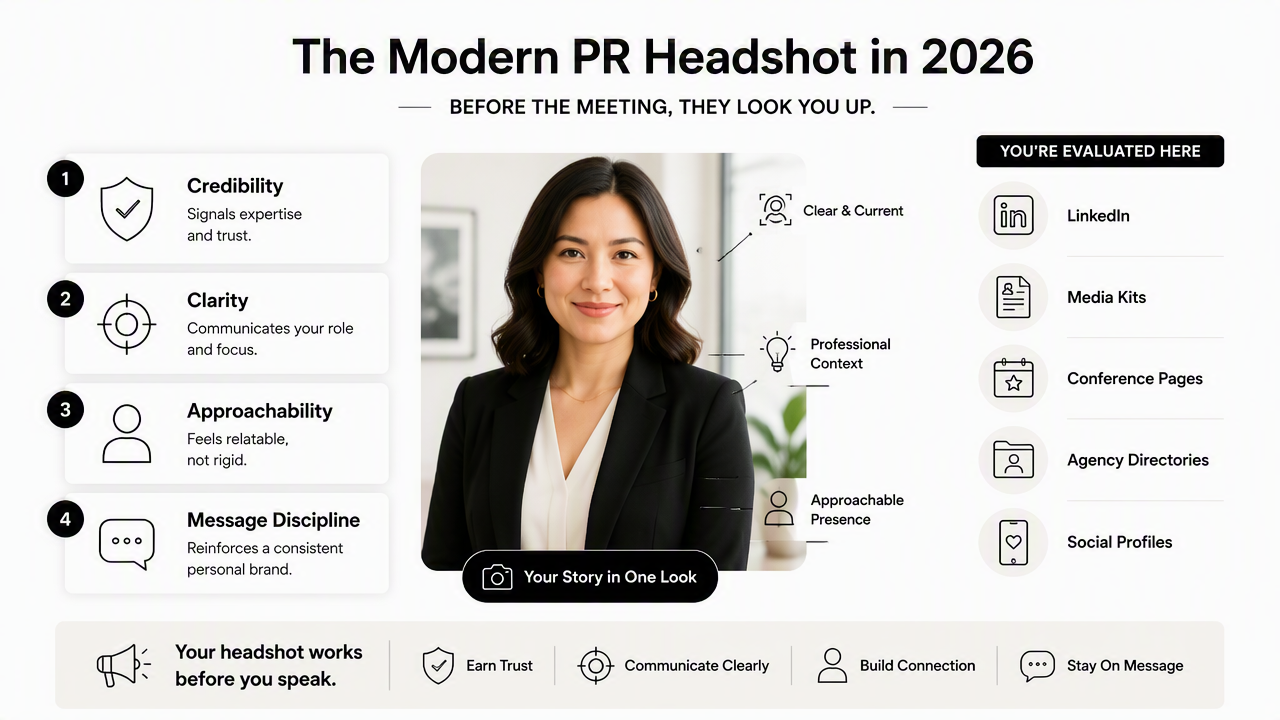
PR roles vary widely. A corporate communications director may need a calmer, more executive image. A consumer brand publicist may need a warmer and more expressive style. A crisis communications advisor may need a steadier, more formal look.
PR headshot style guide by use case
| PR use case | Best visual style | What to avoid |
|---|---|---|
| LinkedIn profile | Natural smile, clean background, business-casual styling | Heavy filters or cropped group photos |
| Agency bio | Consistent lighting, coordinated wardrobe, approachable expression | Different styles across team members |
| Press kit | High-resolution image, neutral background, clear face visibility | Busy backgrounds or trendy effects |
| Event speaker page | Confident posture, warm expression, simple framing | Overly casual selfies |
| Crisis communications bio | Calm expression, understated clothing, minimal distractions | Dramatic lighting or exaggerated poses |
The common thread is control. A headshot should look intentional without feeling staged. That balance matters because PR work often involves persuasion, reputation, and public judgment.
Visual cues that build trust
- Eyes visible and well lit: Helps the face feel open and direct.
- Simple background: Keeps attention on the professional, not the setting.
- Modern but restrained clothing: Signals awareness without looking fashion-led.
- Recognizable likeness: Protects credibility when meeting in person.
- Consistent cropping: Helps team pages and media kits feel organized.
A practical rule works well: if the image would look credible beside a media quote, a panel bio, and a client proposal, it is probably strong enough for PR use.
How should PR professionals create AI headshots safely?
PR professionals should create AI headshots by starting with accurate source photos, choosing a role-appropriate style, reviewing outputs for realism, and keeping final use transparent inside the organization. The safest workflow treats AI as a production tool, not as a way to create a false identity.
The reputational stakes are higher in communications than in many other fields. PR depends on trust, so an image that looks artificial, misleading, or inconsistent can weaken the very message it was meant to support.
A practical workflow for better results
- Collect 10 to 20 recent photos with clear face angles, different expressions, and natural lighting.
- Remove poor inputs such as sunglasses, heavy filters, extreme angles, and outdated images.
- Choose a PR-specific style such as polished, editorial, speaker-ready, or agency bio.
- Generate multiple options so expression, background, and wardrobe can be compared.
- Check likeness carefully against recent real photos.
- Select two final versions for different channels, such as LinkedIn and press kits.
- Store usage notes so teams know which image is approved for which setting.
Research on AI data work also shows why source quality and human review matter. In The Data-Production Dispositif, Milagros Miceli and Julian Posada examined data production practices behind AI systems, emphasizing that AI outputs are shaped by human-labeled and human-managed data processes, not magic automation ACM, 2022.
Common mistakes that weaken credibility
- Using a headshot that changes facial structure too much.
- Choosing a background that looks more like an advertisement than a bio image.
- Matching every team member so closely that the page feels synthetic.
- Publishing a low-resolution file in a media kit.
- Using one casual profile photo across every professional channel.
The best review question is simple: would a journalist, client, or event organizer feel misled after meeting the person on a video call? If the answer is yes, the image needs another pass.
How Looktara handles PR headshots
Looktara handles PR headshots by focusing on polished, professional image generation for real-world profile use, especially where consistency and approachability matter. The Looktara platform is most useful when a communications professional needs fresh visuals for LinkedIn, resumes, portfolio pages, media bios, and public-facing profiles.
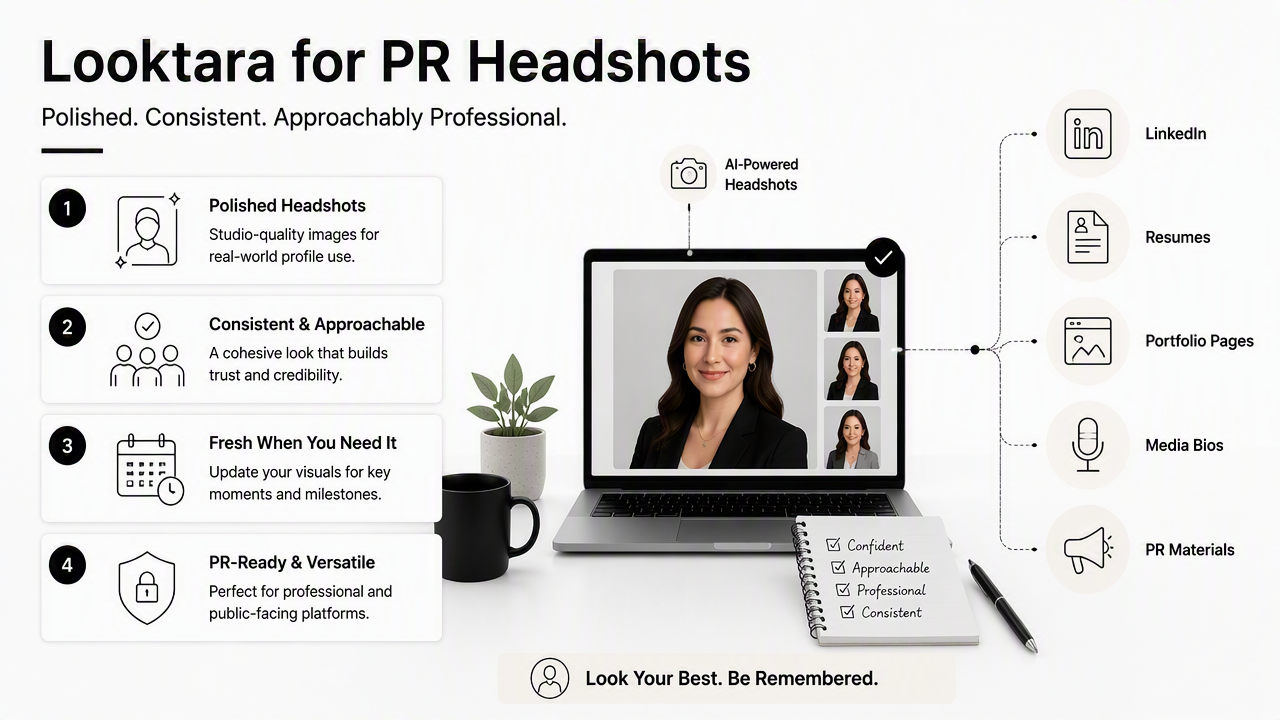
A strong PR image usually sits between corporate and conversational. It should not look like a passport photo, but it also should not look like a lifestyle campaign. Looktara supports that middle ground by making the output feel professional while still suited to personal branding.
AI headshots compared with other options
| Option | Best for | Strength | Tradeoff |
|---|---|---|---|
| AI headshot platform | Fast updates across profiles and bios | Many polished options from existing photos | Requires careful likeness review |
| Traditional photographer | Executive portraits, annual brand shoots | High control over lighting and direction | Higher cost and scheduling time |
| DIY smartphone photo | Quick informal updates | Fast and familiar | Often inconsistent lighting or background |
| Stock-style avatar | Internal mockups or placeholders | Easy to produce | Poor fit for trust-based PR work |
AI works especially well when teams need updated visuals before a launch, hiring push, conference season, or agency refresh. Solo consultants and founders who handle their own public image can also use an AI portrait to look consistent across pitch decks, LinkedIn, and website bios.
For entrepreneurs connecting PR with commerce or personal branding, a profile-focused tool such as a Shopify and resume headshot generator can support founder bios, storefront credibility, and professional profile updates.
Best Looktara style choices for PR work
- Polished editorial: Best for bylines, podcast pages, and media kits.
- Warm professional: Best for agency teams, LinkedIn, and client-facing bios.
- Modern executive: Best for senior communications leaders.
- Creative consultant: Best for boutique PR, influencer relations, and founder-led brands.
Headshot selection should match the communication channel. A warm smile may work best for LinkedIn, while a more composed image may fit a crisis communications bio or investor-facing press page.
What should PR teams expect in 2027?
PR teams should expect AI headshots in 2027 to become more personalized, more consistent across channels, and more closely reviewed for authenticity. The trend points toward faster production, stronger brand controls, and clearer internal policies for AI-generated professional imagery.
AI image tools are moving from novelty to workflow. PR teams already manage tone, approvals, boilerplates, media lists, and spokesperson bios. Headshots are likely to join that same brand governance process.
Likely changes for PR image workflows
- Channel-specific versions: One approved image for LinkedIn, another for media kits, and another for speaker pages.
- Team style presets: Agencies and communications departments may standardize lighting, crop, and background.
- Stronger disclosure norms: Internal teams may label which images are AI-assisted, even when public disclosure is not required.
- Better quality control: Human review will remain important for likeness, bias, and realism.
- Faster refresh cycles: Professionals may update images more often as roles, hairstyles, and brand positioning change.
A 2025 systematic review on retrieval augmented generation in healthcare by Lameck Mbangula Amugongo, Pietro Mascheroni, and Steven E. Brooks shows how sensitive fields are studying ways to ground AI systems in reliable context PLOS Digital Health, 2025. PR is not healthcare, but both fields show the same lesson: AI output needs governance when trust is part of the job.
The practical direction is clear. AI headshots will be normal, but casual use will not be enough. Communications leaders will need standards for likeness, file quality, approved use, and brand fit.
FAQ
FAQ answers clarify the most common concerns about AI portraits for communications roles, especially around credibility, usage rights, realism, and platform fit.
Are AI headshots acceptable for PR professionals?
AI headshots are acceptable for PR professionals when the final image is accurate, current, and not misleading. The portrait should preserve recognizable facial features and match the person's real presentation. For media relations, agency bios, and LinkedIn, credibility matters more than dramatic styling or visual perfection.
Can an AI headshot be used in a press kit?
An AI headshot can be used in a press kit if it is high resolution, realistic, and approved by the person represented. The image should not create confusion during interviews, events, or video calls. A neutral background and clean crop usually work best for journalist downloads and event pages.
How many AI headshot versions should a PR professional keep?
Two to three final versions usually cover most PR needs. One can serve LinkedIn and networking, one can fit press kits or speaker bios, and one can support agency or company pages. Keeping too many versions can create inconsistency across search results and public profiles.
What makes a PR headshot different from a corporate headshot?
A PR headshot often needs to feel slightly more conversational than a traditional corporate portrait. Communications work depends on access, clarity, and relationship building, so warmth matters. Senior PR leaders may still choose a more executive style, but approachability should remain visible.
Conclusion
A strong AI headshot for public relations professionals should make a person look credible, current, and easy to trust across public channels. The next step is simple: gather recent photos, choose a polished but approachable style, review every result for likeness, and publish only the strongest two or three versions.
For a faster refresh across LinkedIn, bios, media pages, and professional profiles, Looktara offers a practical path from everyday images to media-ready portraits. Head to looktara.com when a PR profile needs a clean update before the next pitch, panel, launch, or client introduction.
Generated by EarlySEO.com