
TL;DR
AI profile photos are ethical when they accurately represent a real person and do not change age, identity, body type, credentials, or context. The safest approach is to use AI for polish, lighting, wardrobe, and background quality while keeping disclosure ready for high-trust settings.
AI generated profile photos ethics now matter because a profile image is often the first credibility signal before a recruiter, client, customer, follower, or date reads a single word. Artificial intelligence: computational systems that perform tasks linked to human intelligence, including perception, learning, reasoning, and problem-solving. For people who need professional images without a studio shoot, Looktara can help create polished visual assets when accuracy and context stay intact.
Table of Contents
What makes an AI profile photo ethical?
An AI profile photo is ethical when it represents a real person accurately, uses consent-based source images, and does not create a false impression about identity, age, body, role, location, or professional status.
The core test is simple: if the person could appear at a video call, interview, meeting, or first date and be recognized without awkward explanation, the image is probably within ethical bounds. If the image makes a person look like a different age, body type, profession, or social status, it moves from enhancement into deception.
AI-generated profile photo: a digital portrait created or edited by artificial intelligence from prompts, uploaded images, or both, usually for LinkedIn, resumes, company pages, social profiles, creator accounts, or dating apps.
Key insight: ethical AI portraits should reduce friction, not invent a better version of a person that others will rely on for trust-based decisions.
The practical ethics checklist
A usable ethics standard should be easy to apply before posting. The best rule is accuracy first, polish second, and disclosure when trust depends on the image.
- Use real source photos with permission from the person shown.
- Keep the face, age range, skin tone, body type, and visible identity traits accurate.
- Avoid invented uniforms, awards, workplaces, luxury settings, or credentials.
- Use neutral improvements such as lighting, framing, background cleanup, and wardrobe styling.
- Save the original image set in case a platform, employer, or client asks about authenticity.
- Disclose AI assistance when the image is used in hiring, public leadership, press, or paid influence contexts.
Looktara supports this practical approach by focusing on profile-ready images that can fit real professional and social use cases. Related creators can also build a consistent presence with a fitness Instagram profile picture generator when the goal is recognizable branding rather than identity reinvention.
Where are AI headshots acceptable in 2026?
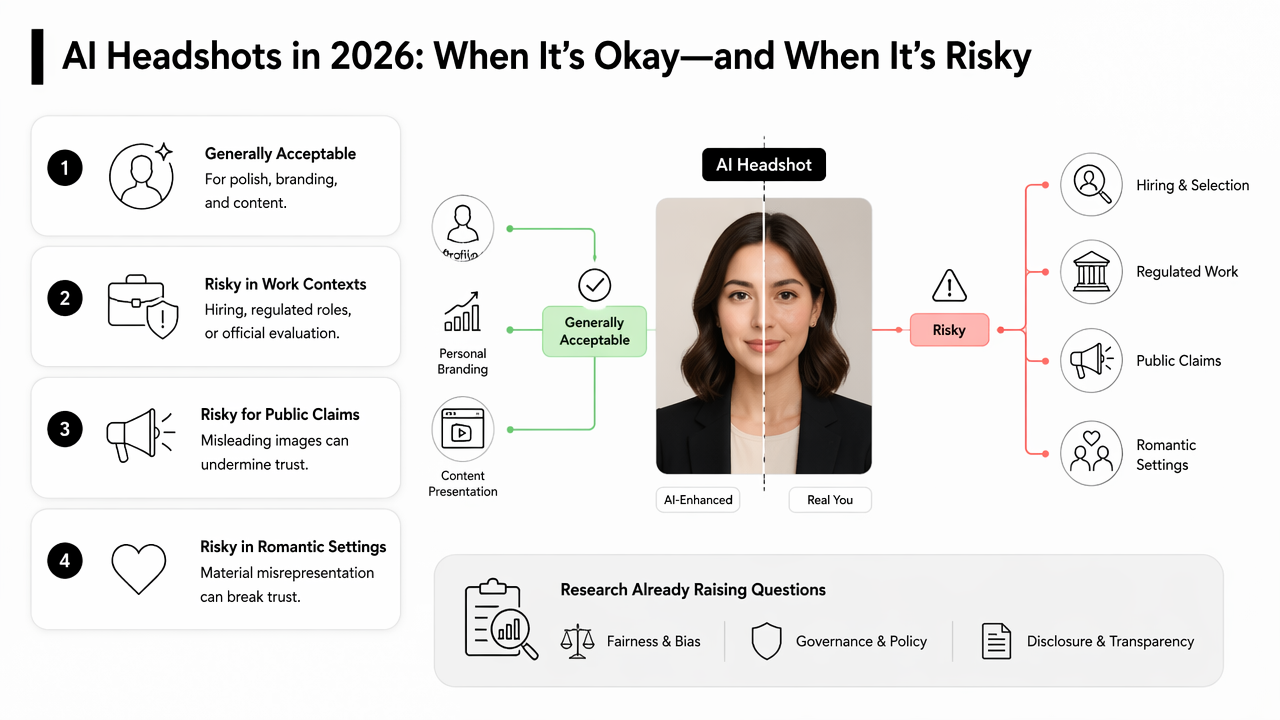
AI headshots are generally acceptable in 2026 for profile polish, personal branding, and content presentation, but they become risky in hiring, regulated work, public claims, and romantic settings when the image materially misrepresents the person.
Research on AI in work settings has already raised governance questions. A 2022 Human Resource Management Review article by Chowdhury, Dey, Joel-Edgar, and colleagues examined AI capability in human resource management, which is relevant because profile images can affect hiring signals even before formal screening begins: study PDF.
Metaverse and avatar research also matters. Park and Kim mapped open challenges for immersive digital environments in a 2022 IEEE Access paper, including identity and application design questions that overlap with AI portraits and digital self-presentation: IEEE Access paper.
Ethical use by platform and context
Different platforms create different expectations. A LinkedIn headshot signals professional credibility. A dating app image signals attraction and identity. A company bio image signals authority on behalf of an organization.
| Context | Usually ethical | Risky or deceptive | Best practice |
|---|---|---|---|
| Cleaner lighting, background, business attire | Younger-looking face, fake office, invented job setting | Match the current appearance and role | |
| Resume or CV | Small professional portrait where culturally normal | Over-edited image used to influence hiring | Follow local hiring norms and keep it realistic |
| Company bio | Consistent team portraits | Fake executive setting or altered seniority cues | Use consistent style across the team |
| Influencer profile | Brand-aligned profile image | Hidden synthetic persona used for paid trust | Disclose when the persona is synthetic or heavily edited |
| Dating app | Better crop, lighting, natural expression | Age, body, face, or lifestyle misrepresentation | Use recent images that match offline appearance |
Professional content can stay consistent across channels. For example, a founder using an AI portrait for LinkedIn may pair it with branded posts from a fitness Shopify LinkedIn post AI generator, as long as the person and business claims remain truthful.
What are the main ethical risks?
The main ethical risks are deception, lack of consent, biased representation, privacy leakage, creator-rights disputes, and loss of trust when audiences discover that a profile image was more invented than edited.
Competitor discussions in the search results often focus on broad AI art concerns, including artist displacement and training-data consent. Those concerns matter, but profile photos add a more personal issue: the image is attached to a real person making real claims in hiring, commerce, dating, or public influence.
A technical study by Chen, Tworek, Jun, and colleagues on large language models trained on code shows how AI systems can perform complex generation tasks from training data and prompts: arXiv paper. The same general lesson applies to images: generated outputs can look convincing without proving that the underlying representation is truthful.
Risk signals that should stop publication
Some edits are not just cosmetic. They change the facts another person may use to make a decision.
- Identity drift: facial features no longer match the real person closely.
- Age shifting: the image makes a person look materially younger or older.
- Body alteration: the image changes size, shape, disability, or physical traits.
- Status inflation: the background implies wealth, authority, travel, office access, or credentials that are not real.
- Cultural or racial distortion: skin tone, hair texture, facial structure, or cultural markers are altered.
- Hidden synthetic persona: an account presents a non-real person as a real founder, employee, creator, or romantic match.
Trust usually breaks not because AI was involved, but because the audience feels a decision was shaped by a false signal.
The distinction matters for creators and small businesses. Edited posts, product visuals, and campaign graphics can be more flexible than identity photos. A brand can experiment with a fitness Instagram product photo AI generator while holding stricter rules for the human faces that represent the brand.
How should AI profile photos be disclosed?
AI profile photos should be disclosed when the image could affect trust, hiring, purchasing, public reputation, or personal safety, while minor edits such as lighting and background cleanup usually do not require a visible label.
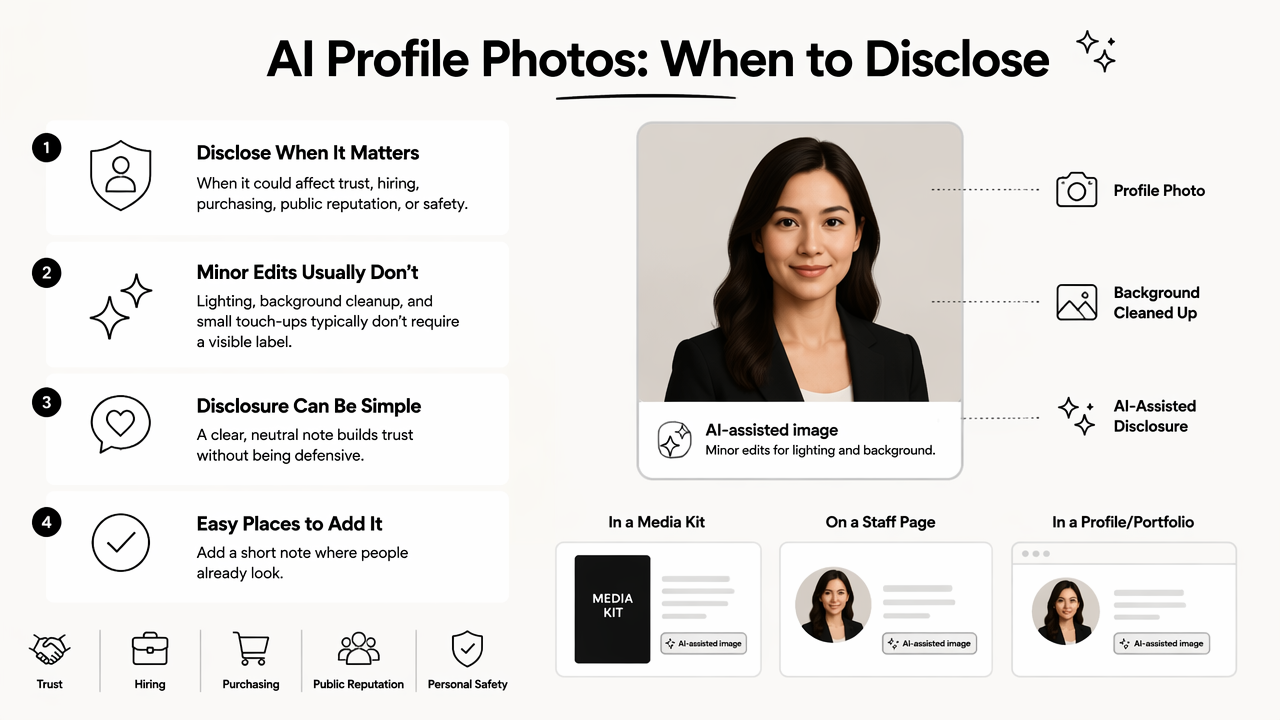
Disclosure does not need to sound defensive. A simple line in a media kit, staff page policy, dating bio, or creator disclosure can say that the portrait was AI-assisted and based on real photos. The phrase should clarify that the image is not a fully synthetic person.
For public professionals, disclosure is also a governance habit. Company pages, press kits, and founder bios may be reused by journalists, investors, customers, and search engines. Consistent labeling prevents confusion as AI images become more common.
A clear disclosure decision guide
The disclosure threshold depends on the level of reliance. The more a viewer depends on the image to judge a person, the stronger the case for disclosure.
- Low disclosure need: lighting correction, crop, background blur, blemish cleanup, color balance.
- Medium disclosure need: AI-generated outfit, studio-style background, composite headshot from several real photos.
- High disclosure need: executive bio, press photo, paid creator profile, recruiting page, political or expert profile.
- Do not use without clear labeling: synthetic spokesperson, avatar posing as a real employee, dating profile that does not match offline appearance.
Creators can apply the same logic to content systems. A polished portrait can sit beside social assets from a fitness Instagram post AI generator, but identity images should meet a higher truth standard than campaign graphics.
The Looktara platform fits best when used as a visual presentation tool, not a way to invent credentials or change a person's identity. For brand teams, looktara.com can be part of a workflow that keeps human representation consistent, current, and recognizable.
What should profile photo ethics look like next?
Profile photo ethics in 2027 and beyond should move toward clear labeling, consent-based image inputs, platform-specific policies, and stronger norms around recognizable identity rather than blanket rejection of AI images.
The likely future is not a ban on AI portraits. More likely, platforms will treat profile images differently depending on risk. A creator avatar, professional headshot, employee directory photo, and dating profile may all face different expectations because the audience relies on each image in a different way.
A fair standard should protect trust without punishing people who lack access to expensive photography. AI tools can help remote workers, freelancers, entrepreneurs, and job seekers look professional. The ethical line appears when better presentation becomes false representation.
FAQ: common questions about AI generated profile photos ethics
Is it ethical to use an AI headshot on LinkedIn?
An AI headshot is ethical on LinkedIn when it is based on real photos and accurately reflects the person's current appearance. It becomes risky when it changes age, facial structure, body type, professional setting, or authority cues. A realistic, recognizable image is the safest choice.
Should AI profile photos be labeled everywhere?
AI profile photos do not need labels for minor cleanup, lighting, or cropping. Labeling is wise when the image is substantially generated, used in high-trust contexts, or attached to commercial influence. Company bios, press pages, and paid creator accounts benefit from clear disclosure.
Are AI dating app photos dishonest?
AI dating app photos are dishonest when they misrepresent age, body, face, lifestyle, or recent appearance. They can be acceptable when used only to improve lighting, background, or image quality. Dating profiles carry a strong expectation that the person shown will match offline reality.
Can a business use AI-generated team photos?
A business can use AI-assisted team photos if every person shown is real, consenting, and recognizable. Fully synthetic employees or altered seniority signals should be labeled clearly. For adjacent brand visuals, a fitness Shopify website hero AI generator can support campaign design without confusing staff identity.
What is the safest rule for job seekers?
The safest rule for job seekers is to use AI only for polish, not personal reinvention. A profile photo should match a live interview appearance. For supporting content, visual tools such as a fitness TikTok ebook cover AI generator can be used more creatively because they do not represent personal identity in the same direct way.
Conclusion
AI generated profile photos ethics comes down to one practical standard: make the person easier to recognize, not easier to misunderstand. Ethical use preserves consent, identity accuracy, context honesty, and disclosure in high-trust settings.
A good next step is to audit every profile image against four questions: Does it still look like the real person, does it imply anything false, was consent clear, and would disclosure change the viewer's reaction? If the answers are clean, AI can be a fair and useful part of professional image creation. For profile-ready visuals that support accurate personal branding, visit looktara.com and build images that strengthen trust rather than test it.
Generated by EarlySEO.com